
Who uses Delphi? The silent success behind astronauts, theme parks, satellites, and a multi-billion ultimate payday!
This article is a translation into Italian of the article “Who Uses Delphi? The Silent Success Behind Astronauts, Theme Parks, Satellites, And A Multi-billion Ultimate Payday!” by Ian Barker. You can find the original article here: https://blogs.embarcadero.com/who-uses-delphi-the-silent-success-behind-astronauts-theme-parks-satellites-and-a-multi-billion-ultimate-payday
Despite Delphi regularly ranking among the top ten development languages worldwide, there still exists this strange and undeserved negativity (whether accidental or intentional) from some people who mistakenly accuse it of being old or obsolete. This is despite the fact that, as you can see on our blog right now, RAD Studio 12.3 has just been released. I’m not entirely sure what the detractors and doom-mongers are worried about. They seem to wrongly claim that Delphi is outdated – which is obviously false – or that it’s not up to date – also not true – didn’t I just mention that RAD Studio version 12.3 with Delphi and C++Builder is now available? Or do they even use the ridiculous word ‘dinosaur’ in reference to Delphi, when in fact, Delphi is the fourth newest language in the top ten!
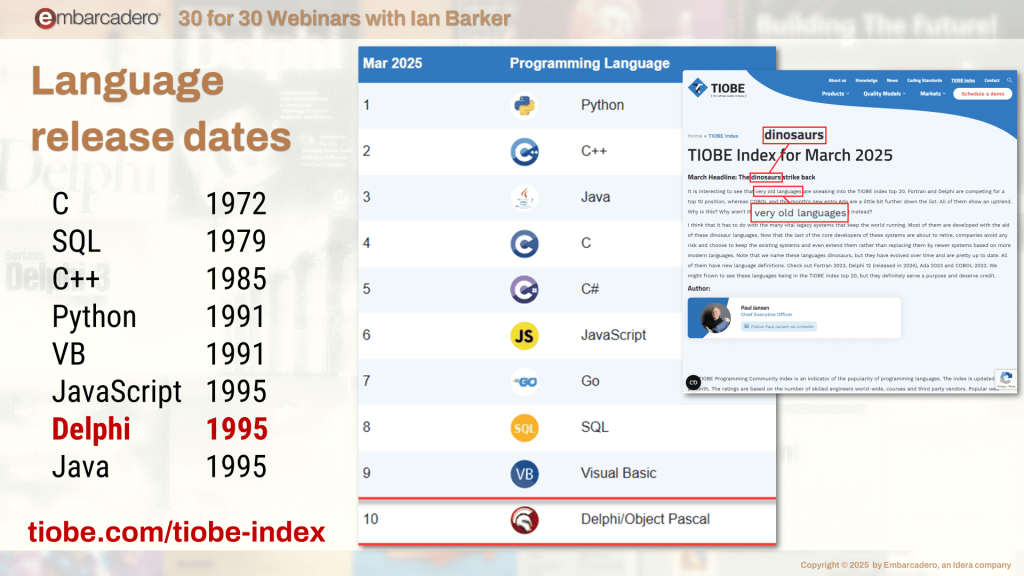
Did you know that Delphi is actually the same age as Java and JavaScript? Delphi is also younger than Python, C++, and SQL.
Even Java is only three months younger than Delphi. Additionally, JavaScript was released in the same year as Delphi.
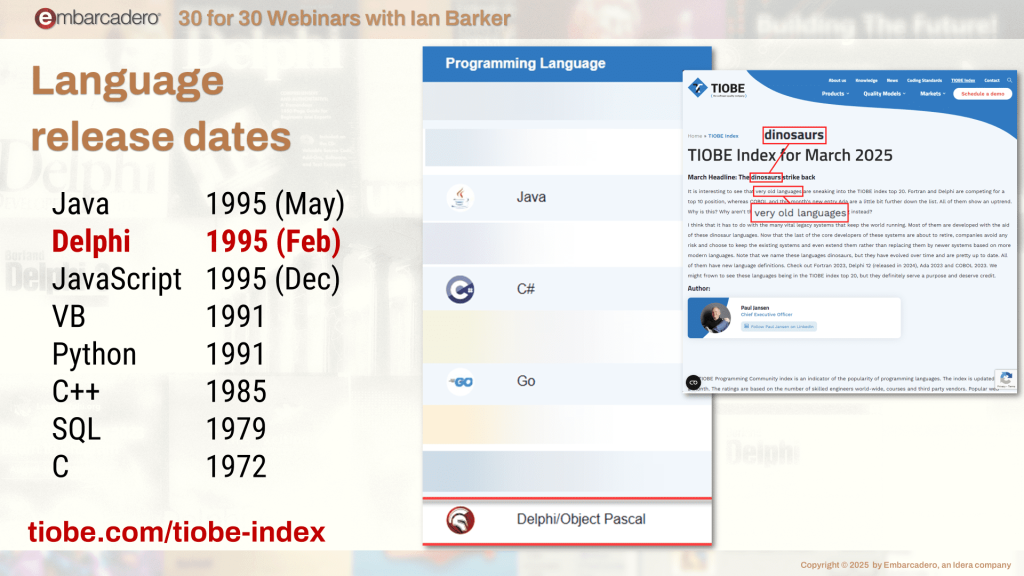
Yet there exists this strange type of bias trying to “push Delphi into a corner” and claim it’s a dinosaur when, in reality, it’s newer than many other well-known programming languages and roughly the same age as most others in the top ten. What exactly are people afraid of? Are they worried that their friends might use Delphi and appreciate it? Are they afraid that the legendary stories about its rock-solid reliability, exceptional performance, and the ability to create native apps that work on Windows, macOS, iOS, Android, and Linux with few or no dependencies might lead unsuspecting travelers on their first steps along the technological path to success? I don’t get it.
Who uses Delphi? Well, actually, a lot of people.
The funniest thing about Delphi is that you’ve almost certainly interacted with a program written in Delphi today. If not today, then almost certainly last month. The reason for this is the enormous number of systems worldwide that are written in Delphi. If you’ve been to an airport, watched TV, or traveled by train, you might very well have had Delphi doing its job behind the scenes. Even if you haven’t done any of these things, 400 km above your head, at some point last week, an astronaut looked down at you with eyes tested by a Delphi app running on a laptop in space.

One single Delphi app reaches 800 million people every year.
A single Delphi app, by AviaVox, broadcasts important safety announcements and travel information to no less than 800 million people worldwide every year in over 35 different languages (Source: Merijn Bosma, AviaVox). During the webinar, I showed slides from Merijn and many other companies that specifically reached out to tell me they used Delphi or that I knew they used Delphi in one way or another. I had so many examples of people, products, and projects using Delphi that I couldn’t include them all. Delphi is so good at quietly succeeding that it’s used wherever you can imagine, yet it doesn’t carry the unreliability of many competing technologies or the instability and fragility of something like a scripting language or web technologies. It also has the raw computing power where, in the right hands, it can rival C++ and Rust while remaining much easier to understand and extremely simple to learn for new users.

The New Pier project at Amsterdam’s Schiphol Airport uses Delphi behind the scenes to control many aspects of the project, including passenger control, gate access security, and many others; reliably, with minimal effort. Not bad for a dinosaur.